

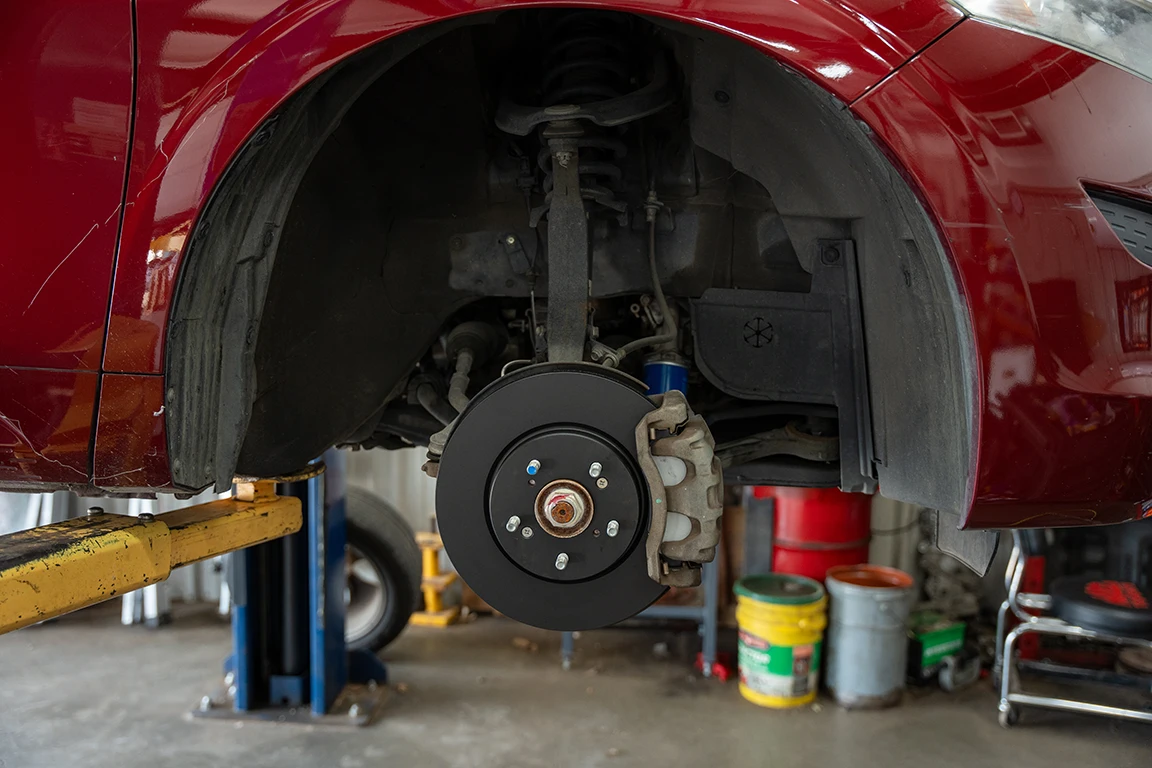
Brake Pad Replacement: Signs, Cost, and What to Expect
Brake pad replacement is the routine service of swapping the worn friction pads that press against your rotors to slow the car. Most vehicles need it every 30,000 to 70,000 miles depending on how they’re driven, and at an independent shop a pad-only job for a typical vehicle generally runs about $150 to $400 per axle. Pads are designed to wear out on purpose, so replacing them on time is normal maintenance, not a sign something failed. It’s one of the most common services covered in brake repair.
What Is Brake Pad Replacement?
Brake pad replacement is the service of removing the worn friction pads from each brake caliper and installing a fresh set before the friction material runs out. It’s routine, wear-based maintenance — expected upkeep, not a repair triggered by a failure.
The pads themselves are the replaceable friction blocks inside each caliper. When you press the pedal, the caliper squeezes a pad against each side of a spinning steel rotor, and the friction slows the wheel — wearing a little material off the pad with every stop. That gradual wear is exactly what the pad is designed to do.
Done on schedule, it’s one of the most straightforward and affordable services a vehicle needs. Done too late, worn-through pads let metal contact the rotor, and a simple pad job turns into a pad-and-rotor job.
What Are the Signs You Need New Brake Pads?
Worn pads announce themselves through sound, feel, and sometimes a dashboard light. The most common signals:
A high-pitched squeal when braking. Most pads have a small metal wear indicator that contacts the rotor as the pad gets low, producing a deliberate squeal to tell you it’s time.
A grinding or growling noise. This usually means the friction material is gone and metal is meeting metal — a sign the job is now urgent and the rotors may be damaged.
Longer stopping distances or a car that takes more pedal to stop. Reduced friction material means reduced braking.
Vibration through the pedal. More often a rotor symptom than a pad one, but the two are related and worth checking together.
A brake wear light. Some vehicles, including certain Hondas and Acuras, use an electronic sensor that illuminates a dash warning when the pads get low.
Any of these is worth an inspection. Grinding in particular shouldn’t wait. Because a squeal or grind can also point to other parts of the system, it’s worth understanding the full range of brake warning signs rather than assuming every noise is the pads.
How Long Do Brake Pads Last?
There’s no single number, because pad life depends far more on how and where a car is driven than on the calendar. Highway miles are gentle on pads; stop-and-go traffic, hills, towing, and hard braking wear them faster.
| Driving Conditions | Typical Front Pad Life |
|---|---|
| Mostly highway, light braking | 50,000+ miles |
| Mixed city and highway | 30,000–50,000 miles |
| Heavy stop-and-go, towing, or hilly terrain | 20,000–30,000 miles |
These are general ranges for typical passenger vehicles and pad materials. The specific figure for any given car depends on its weight, its pad compound, and the driver behind the wheel. The reliable way to track pad life isn’t mileage at all — it’s measuring the remaining thickness, which is why pad checks are part of routine service.
How Are Brake Pads Replaced?
A proper brake pad replacement follows the same sequence whether it’s a Civic or a pickup:
Inspect and measure
The technician measures remaining pad thickness and checks the rotors before any parts come off.
Remove the wheel
The vehicle is raised and the wheel removed to expose the brake assembly.
Remove the caliper
The caliper is unbolted and supported so it doesn’t hang by the brake hose.
Remove the old pads
The worn pads and any worn hardware clips come out.
Check the rotor
The rotor is measured against its minimum thickness specification and either reused, resurfaced, or replaced.
Install the new pads
Fresh pads and new hardware go in, often with a lubricant on the contact points to prevent noise.
Reassemble and torque
The caliper is reinstalled and the wheel is torqued to the manufacturer’s specification.
Reset and bed in
Any electronic wear sensors are reset, and the new pads are seated with a series of controlled stops.
The whole job is typically an hour or two per axle. What separates a good brake job from a cheap one is usually steps one and five — the measuring — and the quality of the pads that go back on.
How Much Does Brake Pad Replacement Cost?
For a typical passenger vehicle at an independent shop, a pad-only replacement — new pads on rotors that are still in spec — generally runs about $150 to $400 per axle, or roughly $300 to $700 for all four wheels, including parts and labor. If the rotors also need replacing, expect the per-axle figure to move up toward $300 to $700, since rotors and the extra labor add to the total.
Several factors move a specific quote within those ranges:
| Cost Factor | Effect on Price |
|---|---|
| Pad material (organic, semi-metallic, ceramic) | Premium compounds cost more up front but can last longer and run quieter |
| Whether rotors are replaced or resurfaced | The single biggest swing in a brake job’s total |
| Front vs. rear | Rears can cost slightly more when the parking brake is integrated |
| Vehicle type | Trucks, SUVs, and performance models use larger, pricier components |
| OEM vs. aftermarket parts | Genuine manufacturer parts typically cost more than aftermarket |
| Independent shop vs. dealership | Dealerships generally charge higher labor rates than independent shops |
Two things are worth knowing. First, mainstream vehicles like most Hondas and Acuras tend to sit at the more affordable end, because their parts are common and the job is straightforward — a real advantage of driving a car a shop knows well. Second, no honest range replaces an actual quote. Pricing depends on what the inspection finds, and a shop can’t give a firm number until it has measured the pads, the rotors, and the hardware on the specific vehicle.
Not sure what your brakes need?
Should You Replace the Rotors at the Same Time?
Not always. Rotors and pads wear together, but rotors last longer, and whether they need replacing comes down to measurement, not habit. A technician checks:
If the rotors are within spec and in good shape, new pads alone are the right call. If they’re worn past spec or damaged, replacing pads without addressing them just wears the new pads prematurely. A shop that automatically replaces rotors on every job — or one that never does — is worth a second question either way.
Do Front and Rear Brake Pads Wear the Same?
No, and the difference is physics. When a car brakes, its weight shifts forward onto the front wheels, so the front brakes do the majority of the stopping work and the front pads wear out faster.
| Front Brake Pads | Rear Brake Pads | |
|---|---|---|
| Share of braking work | Roughly 70% | Roughly 30% |
| Wear rate | Faster; replaced more often | Slower; last longer |
| Typical job complexity | Usually simpler | Can be more involved if the parking brake is integrated |
This is why a shop replacing only your front pads isn’t cutting corners — it’s common and correct for the fronts to need service well before the rears. Replacing pads in axle pairs (both fronts or both rears together) is standard, since brakes must apply evenly side to side.
Can You Replace Brake Pads Yourself?
Mechanically, a pad swap is one of the more approachable jobs for a confident home mechanic. But brakes are the system that stops the car, and a few details separate a safe job from a dangerous one.
| Doing It Yourself | Professional Replacement | |
|---|---|---|
| Tools needed | Jack, stands, sockets, caliper tool, torque wrench | Provided |
| Rotor measurement | Requires a micrometer and knowing the spec | Measured as standard |
| Torque to spec | Critical — over- or under-torquing causes real problems | Done to manufacturer spec |
| Sensor reset and bed-in | Varies by vehicle; some need a scan tool | Handled |
| Risk if done wrong | Brake failure, damaged rotors, uneven braking | Backed by the shop |
For an experienced DIYer with the right tools, it’s a reasonable Saturday job. For everyone else, the small savings rarely justify the stakes on a safety system, and a professional inspection often catches a caliper or hose problem a pad swap alone would miss.
Frequently Asked Questions
How long does brake pad replacement take?
Can I replace just the pads and not the rotors?
How often should brake pads be replaced?
Are ceramic brake pads worth it?
Is it safe to drive with worn brake pads?
When New Pads Aren’t Enough
Sometimes the pads are only half the story. If the rotors are warped, scored, or worn past their minimum thickness, fresh pads alone won’t restore smooth, quiet braking — and they’ll wear faster against a damaged surface. That’s a question of rotor wear and thickness, and it’s the natural next step when your pads are due, since the two services so often go together.
If your brakes are squealing, grinding, or just not feeling the way they used to, the team at Ian’s Auto Service can measure exactly what’s left and show you what we find. Serving drivers across the Tulsa metro since 1995, we bring Honda Master Technician expertise to Hondas, Acuras, and every major brand on the road — with straight answers about what your brakes actually need and what they don’t.