

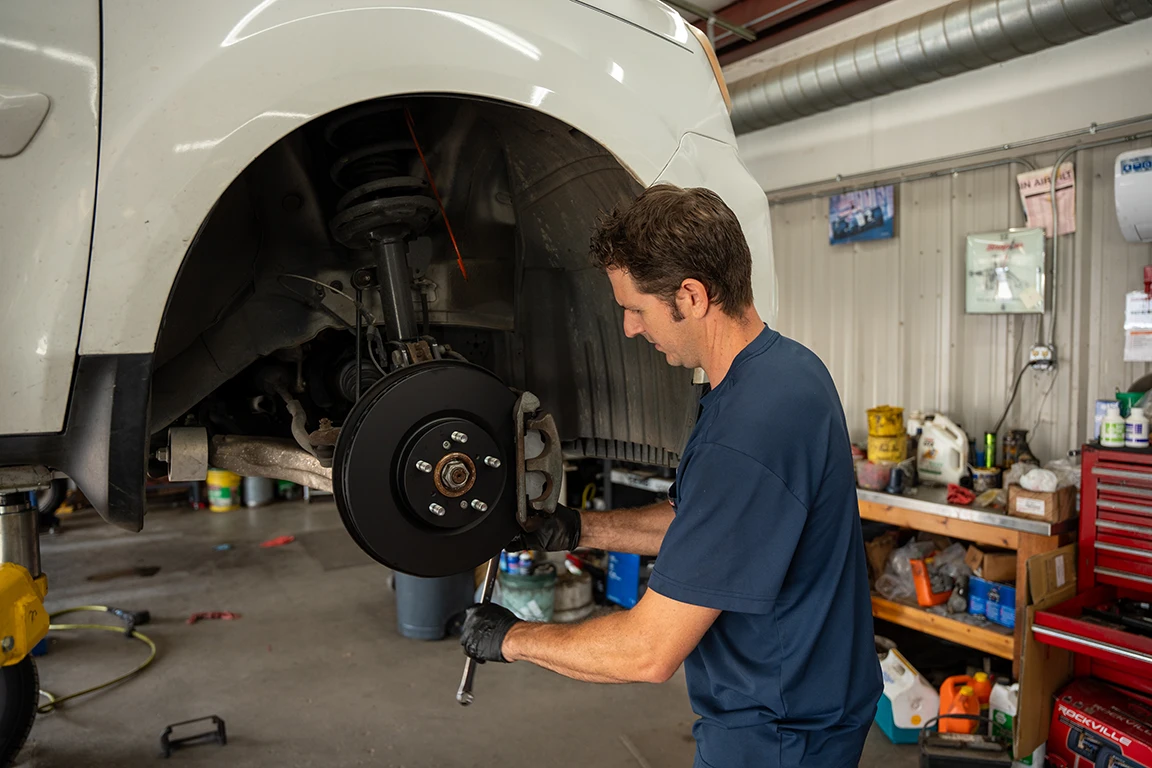
Your brakes are the only system on your vehicle you rely on to save your life several times a day without ever thinking about it. Every stop sign, every red light, every time somebody merges without looking — your brake system absorbs that demand and converts it into heat, quietly, thousands of times a month. When it starts to wear out, it usually tells you first.
The trouble is that most drivers don’t know what they’re listening for, or which sounds mean “schedule an appointment this week” versus “pull over now.” Here’s what you need to know about how your brake system works and when you need brake repairs.
How Your Brake System Actually Works
Pressing the brake pedal doesn’t stop your car. It starts a chain reaction that does.
The pedal pushes a rod into the master cylinder, which pressurizes brake fluid. That fluid travels through steel lines and flexible rubber hoses to each wheel, where it forces a piston inside the caliper to squeeze two brake pads against a spinning steel disc called a rotor. Friction between pad and rotor turns your car’s forward motion into heat, and that heat dissipates into the air. Your car slows down because the energy has to go somewhere.
Every component in that chain matters. A leaking hose, a seized caliper piston, contaminated fluid, or a pad worn down to its backing plate can each compromise the system in a different way — and each announces itself differently.
The Warning Signs Drivers Notice First
Brake problems rarely arrive without notice. They announce themselves through sound, feel, and behavior, and learning to read those signals is the difference between a routine repair and an expensive one.
- A high-pitched squeal when braking. Most brake pads include a small metal wear indicator designed to contact the rotor and squeal once the friction material gets low. That sound is engineering, not failure — it’s the pad asking to be replaced before it damages anything else.
- A grinding or growling noise. This usually means the pad material is gone and metal is contacting metal. Rotor damage is often already happening.
- A soft or sinking pedal. If the pedal travels farther than it used to, or slowly sinks toward the floor while you hold it at a light, that points toward the hydraulic side — a fluid leak, air in the lines, or a failing master cylinder.
- Pulling to one side during braking. A caliper that isn’t releasing evenly, or a collapsed brake hose, can apply more force at one wheel than the other.
- Vibration or pulsation through the pedal. Commonly caused by rotors with uneven thickness, which develops from heat, wear, or improperly torqued wheels.
Any one of these is worth having looked at. A sinking pedal or a grinding noise is worth having looked at immediately.
Pads and Rotors: The Parts That Wear on Purpose
Brake pads are designed to be sacrificial. They wear down so your rotors don’t, and replacing them on schedule is the single most effective thing you can do to keep brake service affordable.
How long a set lasts depends far less on mileage than on how you drive. A vehicle that spends its life on the highway at a steady 65 may go well past 50,000 miles on a set of pads. The same vehicle running stop-and-go traffic every morning might need them at half that. Towing, hills, aggressive driving, and heavy loads all accelerate wear.
Rotors are a different question. They can often be resurfaced — machined smooth again — if they have enough thickness remaining, but every rotor has a minimum thickness specification stamped into it by the manufacturer. Machine below that number and the rotor can no longer absorb heat safely. Deciding between resurfacing and replacement isn’t a preference. It’s a measurement.
The Hydraulic Side: Calipers, Cylinders, and Lines
The parts that move the fluid tend to fail more quietly than the parts that create friction.
A caliper contains a piston that extends to press the pads and retracts to release them. When the piston or its slide pins corrode, the caliper can stick — dragging the pad against the rotor continuously. Drivers often report a burning smell after a highway trip, reduced fuel economy, or one wheel noticeably hotter than the others. Left alone, a dragging caliper cooks the pad, warps the rotor, and boils the fluid.
The master cylinder sits at the other end of the system. It’s the component that generates hydraulic pressure in the first place, and when its internal seals wear, pressure bleeds past them instead of reaching the wheels. That’s the sinking pedal.
Between them run steel lines and rubber hoses. Steel lines corrode from the outside, particularly where road salt and moisture collect. Rubber hoses degrade from the inside, sometimes swelling internally in a way that lets fluid in but not back out — which is one of the stranger causes of a brake that won’t release.
Brake Fluid: The Component Nobody Thinks About
Brake fluid is hygroscopic, meaning it absorbs moisture from the air over time, even in a sealed system.
This matters because water boils at a far lower temperature than brake fluid does. Hard braking generates enormous heat, and moisture-contaminated fluid can vaporize under that heat. Vapor compresses; liquid doesn’t. The result is a pedal that goes soft exactly when you need it most — descending a grade, or in a panic stop.
Fluid also darkens as it absorbs moisture and picks up debris from internal component wear, which is why a technician can learn a great deal from simply looking at it. Manufacturers publish replacement intervals for brake fluid the same way they do for oil, and it remains one of the most overlooked services on the maintenance schedule.
ABS, Traction Control, and the Electronic Layer
Modern brake systems do more than clamp. Anti-lock braking uses a wheel speed sensor at each corner to detect the moment a wheel stops rotating during a stop, then rapidly modulates hydraulic pressure to that wheel so it keeps turning and you keep steering. That rapid pulsing through the pedal during a hard stop on wet pavement isn’t a malfunction — it’s the system working.
Stability and traction control systems build on the same sensors and the same hydraulic hardware. Honda and Acura vehicles use a system called VSA, which can apply an individual brake to help correct a skid.
When an ABS or VSA light illuminates, the base brake system typically still functions — but the electronic assistance may not. A dirty or failed wheel speed sensor, a damaged tone ring, or a fault in the hydraulic control unit will each set a code, and reading that code is where diagnosis starts rather than ends.
Drum Brakes and the Emergency Brake
Not every wheel uses a disc. Plenty of vehicles still use drum brakes at the rear, where curved brake shoes press outward against the inside of a spinning drum. Drums are less expensive to manufacture and work well at the rear, where less braking force is required — the weight of a car shifts forward under braking, which is why front brakes wear faster than rear brakes on nearly every vehicle.
The emergency brake, which you may know as the parking brake, handbrake, or e-brake, is a separate mechanical system that bypasses the hydraulics entirely. A cable — or on newer vehicles, a small electric motor at the caliper — physically holds the rear brakes engaged. Because it’s mechanical rather than hydraulic, it still works if the hydraulic system fails, which is the origin of the “emergency” name.
Parking brakes fail from disuse more often than from overuse. Cables seize when they sit unused, particularly on vehicles that spend their lives on flat ground with the transmission in park doing all the holding. Using the emergency brake regularly is the simplest way to keep it working.
How Climate and Road Conditions Change Brake Wear
Driving conditions shape wear in ways that national maintenance charts don’t account for.
Heat is the big one. Brakes convert motion into heat, and a system that starts the process at 100 degrees ambient has less thermal headroom than one starting at 60. Stop-and-go traffic in July compounds it. Humidity accelerates moisture absorption into brake fluid, and pothole damage can knock wheels out of alignment in ways that cause uneven brake wear over time.
None of this means your brakes are in trouble. It means that in a hot, humid climate with rough pavement, the inspection interval matters more than the odometer does.
How Often Brakes Should Be Inspected
Most manufacturers recommend a brake inspection at least annually, and it’s common practice to check pad thickness at every tire rotation — which conveniently puts eyes on the system every few thousand miles without an extra appointment.
At Ian’s Auto Service, brake inspections are part of a digital vehicle inspection. Technicians photograph what they find, so you see the actual measured thickness of your pads and the actual condition of your rotors rather than taking a description on faith. If your pads have plenty of life left, the photos show that too.
That transparency is the point. Brake work is safety work, and no customer should ever feel talked into it.
When It’s Time to Schedule Brake Service
Brakes are a system, not a part. Pads, rotors, calipers, fluid, hoses, and electronics all depend on one another, and a symptom in one place frequently originates in another. A pulsating pedal might be a rotor problem — or a wheel bearing, or a sticking caliper that overheated the rotor in the first place. Sorting that out takes measurement and experience rather than guesswork.
Ian’s Auto Service has served drivers across the Tulsa metro since 1995, bringing Honda Master Technician expertise to Hondas, Acuras, and every other major brand on the road. If something about the way your vehicle stops has changed — a new sound, a longer pedal, a pull you didn’t have last month — our team would be glad to take a look and show you exactly what we find. Schedule your brake service today!