

Brake Rotor Replacement: Signs, Cost, and When to Replace
Brake rotor replacement is the service of swapping the steel discs your brake pads clamp against to slow the car. It’s one of the core services covered under brake repair. Rotors wear slower than pads but don’t last forever, and at an independent shop, replacing rotors and pads together usually runs about $300 to $600 per axle for a typical vehicle. Whether a rotor can be resurfaced or has to be replaced comes down to one thing: how much metal is left.
What Is Brake Rotor Replacement?
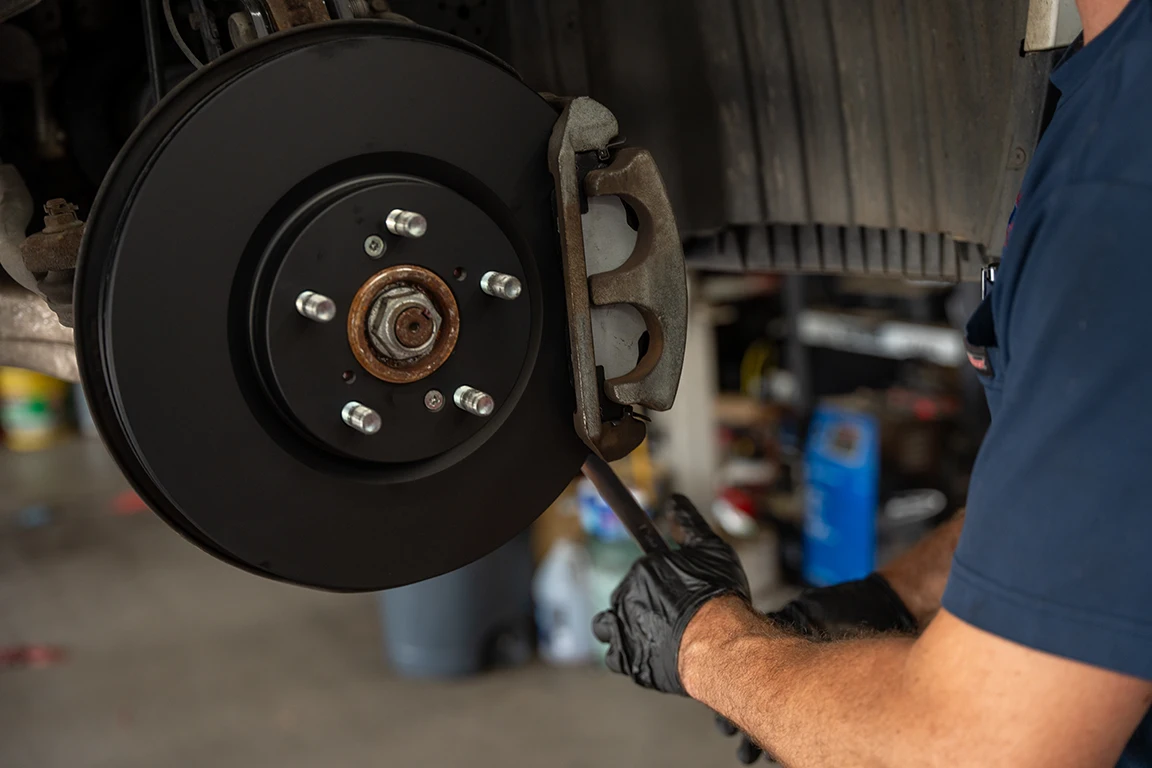
Brake rotor replacement is the service of removing the worn or damaged brake discs and installing new ones. The rotor is the smooth steel disc that spins with each wheel; when you brake, the pads squeeze both sides of it, and the friction slows the car.
Because the pads press directly against the rotor, the two wear as a system. Every hard stop puts heat and friction into the rotor surface, and over time that surface wears thin, develops grooves, or distorts from heat. Replacement restores a flat, full-thickness surface for the pads to grip. It’s often done alongside a pad replacement, since the labor to reach one is most of the labor to reach the other.
What Are the Signs of a Bad Brake Rotor?
Rotor problems tend to show up through feel and sound more than anything you’d see from the driver’s seat. The most common signs:
Vibration or pulsation through the brake pedal. The classic rotor symptom. When a rotor varies in thickness or has warped from heat, the pads grab unevenly as it spins, and you feel a rhythmic shudder through the pedal or steering wheel when braking.
Squealing or scraping that changes with speed. A scored or glazed rotor surface can produce noise that rises and falls with how fast the wheel is turning.
Grooves or scoring you can see or feel. Deep circular grooves in the rotor face, often from pads that were run down to metal, are a sign the surface is compromised.
A blue tint on the rotor. Severe heat can discolor the metal, a sign the rotor has been stressed beyond what it’s designed for.
Longer stopping distances. A worn or uneven rotor surface gives the pads less to grip.
Vibration when braking is the symptom most people notice first, and it’s the one most reliably tied to the rotors specifically rather than the pads.
Can Warped Rotors Be Resurfaced Instead of Replaced?
Warped or worn rotors can sometimes be resurfaced instead of replaced, but less often than drivers expect, and the deciding factor is thickness. Every rotor is stamped with a minimum thickness specification. Resurfacing, also called turning or machining, shaves a thin layer off the rotor to restore a flat, smooth surface, but it also makes the rotor thinner. A technician checks:
Modern rotors are made thinner and cheaper than they used to be, and the labor to machine one often costs as much as a new rotor. For that reason, many shops replace rather than resurface once a rotor is worn or damaged. That isn’t an upsell — it’s that a rotor shaved too thin can’t manage heat and is a safety compromise. A shop should be able to show you the measured thickness and the spec, so the decision rests on a number, not a judgment call.
How Are Brake Rotors Replaced?
Replacing a rotor follows a clear sequence, and because the caliper and pads have to come off to reach it, pads are usually serviced in the same visit:
The technician measures rotor thickness against the minimum spec and checks the pads and hardware.
The vehicle is raised and the wheel removed to expose the brake assembly.
The caliper is unbolted and supported so it never hangs by the brake hose.
The worn rotor is pulled off the hub, sometimes after freeing rust or a retaining screw.
The mounting face is cleaned so the new rotor sits perfectly flat — a skipped step here can cause the same vibration the job was meant to fix.
The fresh rotor goes on, often with new pads and hardware since the caliper is already off.
The caliper is reinstalled and the wheel torqued to the manufacturer’s specification.
A series of controlled stops transfers an even layer of pad material onto the new surface and seats everything in.
The job typically takes one to two hours per axle. The quiet details — cleaning the hub, torquing to spec, bedding in — are what separate a smooth, quiet result from a comeback.
How Much Does Brake Rotor Replacement Cost?
For a typical passenger vehicle at an independent shop, replacing rotors and pads together generally runs about $300 to $600 per axle, or roughly $700 to $1,400 for all four wheels, parts and labor included. Because the caliper has to come off either way, rotors and pads are almost always replaced at the same time, so most real-world quotes cover both.
Several factors move a specific quote within those ranges:
| Cost factor | Effect on price |
|---|---|
| Rotor quality tier (economy, mid-grade, premium coated) | Premium and coated rotors resist rust and warping but cost more |
| Rotor type (vented, solid, drilled, slotted) | Performance and drilled/slotted rotors cost more than standard |
| Front vs. rear | Rear axles with an integrated electronic parking brake can add labor |
| Vehicle type | Trucks, SUVs, and performance models use larger, pricier rotors |
| OEM vs. aftermarket parts | Genuine manufacturer rotors typically cost more than aftermarket |
| Independent shop vs. dealership | Dealership labor rates and OE parts run significantly higher |
Two notes worth keeping in mind. National estimators sometimes quote $900 or more per axle; that figure blends in dealership labor rates and OE parts, and an independent shop generally comes in well under it. And mainstream vehicles tend to sit at the affordable end, because their rotors are common parts and the job is straightforward. As always, a firm number requires measuring the specific vehicle — contact the shop for an accurate quote rather than relying on a range.
Feeling a shudder when you brake? We’ll measure your rotors and show you exactly where they stand.
Schedule ServiceHow Long Do Brake Rotors Last?
Rotors outlast pads, but their life depends heavily on driving style, climate, and how diligently the pads were replaced. Running pads down to metal is the fastest way to ruin a rotor early.
| Driving conditions | Typical rotor life |
|---|---|
| Mostly highway, gentle braking | 70,000+ miles |
| Mixed city and highway | 50,000–70,000 miles |
| Heavy stop-and-go, towing, or hilly terrain | 30,000–50,000 miles |
These are general ranges for typical vehicles. A good rule: rotors often last through two sets of pads, so the second or third pad replacement is a common point for rotors to need attention too. The reliable measure isn’t mileage but thickness, which is why rotors get checked during every brake service.
Should You Replace Rotors in Pairs?
Yes. Rotors are always replaced in axle pairs — both fronts together or both rears together — never just one side.
This is standard practice, not an upsell. Replacing rotors one side at a time would leave the axle braking with mismatched surfaces, which undermines the whole point of the repair.
What Types of Brake Rotors Are There?
Most vehicles use one of a few rotor designs, and the right one depends on the vehicle and how it’s driven:
| Rotor type | How it works | Best for |
|---|---|---|
| Vented | Two faces with vanes between them to shed heat | The front axle on most modern vehicles |
| Solid | A single solid disc, lighter duty | Rear axles and lighter vehicles |
| Drilled | Holes bored through the face to release heat and gas | Performance and wet-weather driving |
| Slotted | Grooves cut across the face to clear debris and gas | Towing, performance, and heavy use |
For the vast majority of daily drivers, a quality standard rotor that matches the manufacturer’s specification is the right choice. Drilled and slotted rotors look aggressive and suit performance or heavy-duty use, but they cost more and can wear pads faster, so they’re rarely necessary on an everyday commuter.
Frequently Asked Questions About Brake Rotor Replacement
Is a brake disc the same as a rotor?
A brake disc and a brake rotor are the same component — two names for the spinning steel disc the pads clamp against to slow the wheel. “Rotor” is the common term in the United States, while “disc” is used more often elsewhere, but both refer to the identical part.
How many brake pads are there per rotor?
Each rotor has two brake pads, one pressing on each side, held by the caliper that straddles the rotor. That works out to four pads per axle and eight on a typical four-wheel vehicle. Both pads squeeze the rotor at once so the wheel slows evenly.
What is a vented brake rotor?
A vented brake rotor has two braking faces with vanes cast between them, forming channels that let air flow through and carry heat away. Most modern vehicles use vented rotors on the front axle, where braking produces the most heat, and simpler solid rotors on the rear.
How much does a brake rotor weigh?
A brake rotor’s weight depends on the vehicle, but most passenger-car rotors weigh roughly 10 to 25 pounds each. Trucks, SUVs, and performance vehicles use larger, heavier rotors, and a rotor loses a small amount of weight as its surface wears over time.
What does a bad brake rotor look like?
A bad brake rotor often shows deep circular grooves or scoring across its face, a pronounced raised lip around the outer edge, rust pitting, or a bluish tint from overheating. Some worn rotors look nearly normal to the eye and reveal their condition only when measured against the minimum thickness specification.
What does a warped brake rotor look like?
A warped brake rotor usually looks normal to the naked eye, because the distortion is rarely a visible bend. It shows up through feel — a pulsation through the pedal when braking — and through measurement, where a technician finds uneven thickness or runout. Severe heat can leave discoloration or hard spots on the surface.
What causes a brake rotor to warp?
Brake rotors warp mainly from heat. Hard or prolonged braking, riding the brakes down a long grade, or parking with very hot brakes can leave uneven deposits of pad material or create uneven thickness across the rotor. Unevenly torqued wheel lug nuts and pads worn down to metal are other common causes.
Do you have to replace rotors when you replace brake pads?
You don’t always need new rotors when you replace the pads. If the rotors still meet their minimum thickness specification and aren’t warped or badly scored, new pads alone are fine. It comes down to measuring the rotors during the brake service.
Can you just replace one rotor?
Rotors are replaced in axle pairs, both fronts or both rears together, so braking stays even side to side. Replacing a single rotor isn’t recommended.
How long does brake and rotor replacement take?
Brake and rotor replacement most often takes one to two hours per axle, and a little longer when pads, hardware, and both axles are done in the same visit.
Is it safe to drive with warped rotors?
A mild pulsation from warped rotors isn’t an immediate emergency, but it worsens over time and lengthens stopping distances. Warped rotors should be addressed before they damage other brake components.
Are drilled and slotted rotors worth it?
Drilled and slotted rotors can help manage heat for performance driving, towing, or heavy use. For a typical daily driver, standard rotors that meet the manufacturer’s spec perform well and cost less.
Rotors and pads are a matched set, and they wear together. If your rotors are due, the pads almost always are as well, since the two share the same job and the same labor to reach them. That’s why a complete brake job usually means replacing the brake pads at the same time rather than addressing one in isolation.
If you’re feeling a shudder when you brake, hearing a new noise, or just aren’t sure how much life your brakes have left, the team at Ian’s Auto Service can measure exactly what’s there and show you the numbers. Serving drivers across the Tulsa metro since 1995, with straight answers about what your brakes need and what they don’t.
Get a clear, measured read on your brakes and a straight answer on what they need.
Schedule Service