The engine is the one component drivers are most afraid of and least equipped to understand. It sits under the hood as a sealed mystery, and when something goes wrong, the imagination usually jumps straight to the worst and most expensive possibility. Most of the time, the reality is far more manageable — but only if the problem is understood early and diagnosed correctly.
Engine repair isn’t a single thing. It’s a category that spans everything from a five-minute spark plug swap to a complete rebuild, and the distance between those two is enormous. Knowing roughly where a given symptom falls on that spectrum is the difference between an informed decision and a panicked one.
How Your Engine Actually Works
Every gasoline engine runs on the same basic idea: controlled explosions, thousands of times a minute, converted into motion.
Air and fuel enter a cylinder. A piston rises and compresses that mixture into a tight space. A spark plug ignites it, and the resulting expansion drives the piston back down with force. That force turns the crankshaft, which ultimately turns the wheels. Then the spent gases are pushed out the exhaust, and the cycle repeats. Intake, compression, combustion, exhaust — the four strokes that have powered cars for over a century.
Everything else in the engine exists to support that cycle or manage its consequences. Oil keeps the moving parts from grinding themselves apart. The cooling system carries away the tremendous heat combustion produces. Timing components make sure the valves open and close at exactly the right instant. When people talk about engine repair, they’re almost always talking about one of these supporting systems rather than the combustion itself.
That’s reassuring, because it means most engine problems are localized. A failure in one system doesn’t have to mean the whole engine is finished.
The Sounds That Signal Trouble
An engine communicates through sound, and a technician learns to read those sounds the way a doctor reads a heartbeat.
A deep, rhythmic knocking that speeds up with the engine is one of the more serious noises, because it can point toward worn bearings deep in the engine’s rotating assembly. A metallic ticking might be a valvetrain issue or something as ordinary as low oil. A squeal on startup usually lives outside the engine’s core, in the belt system. Each sound has its own list of likely suspects, and the location, timing, and pitch all narrow it down.
The mistake drivers make is waiting to see if a new noise “goes away on its own.” Engine noises rarely do. They tend to mark the beginning of a wear pattern, and the window for a smaller repair is widest right when the sound first appears.
Rough Running, Misfires, and Sputtering
When an engine hesitates, shakes at idle, or stumbles under acceleration, one or more cylinders usually aren’t firing cleanly.
This is one of the most common reasons a vehicle comes in for engine work, and the causes range widely — a worn spark plug, a failing ignition coil, a vacuum leak, a clogged fuel injector, or a sensor feeding the engine bad information. Because so many different failures produce the same rough-running symptom, this is a problem that rewards proper diagnosis over guesswork. Replacing parts one at a time until the shaking stops is an expensive way to find an answer.
A car that sputters or loses power under acceleration deserves its own closer look, since the pattern of when it happens often points straight at the cause.
Spark, Fuel, and the Ignition System
The spark plugs and ignition coils are the components most directly responsible for turning fuel into power, and they’re also among the most routine to service.
Spark plugs wear gradually. The gap where the spark jumps widens over tens of thousands of miles, and eventually the spark weakens enough to cause misfires, harder starts, and a measurable dip in fuel economy. Replacing them on schedule is one of the least expensive forms of preventive engine care there is, and on many engines it restores a smoothness the driver had stopped noticing they’d lost.
Ignition coils, which supply the high voltage the plugs need, tend to fail more suddenly. When one goes, it usually takes a single cylinder offline and triggers a noticeable misfire along with the check engine light.
Oil Leaks and Consumption
Oil is what stands between your engine’s moving metal parts and catastrophic wear, which is why anything affecting oil deserves attention.
Two distinct problems get confused with each other. An oil leak means oil is escaping the engine and ending up on your driveway or the shop floor — usually from a failing gasket or seal that can be traced to its source and replaced. An engine burning oil means oil is being consumed internally, drawn into the combustion chamber and burned along with the fuel, often showing up as a faint blue tint in the exhaust or a steadily dropping dipstick with nothing on the ground.
The two have different causes and different repairs, even though both leave you low on oil. Telling them apart is the first step, and it’s not always obvious from the driver’s seat. What they share is urgency: an engine run low on oil for long enough will fail in ways that no repair can undo.
Timing Components: Belts and Chains
Deep in the engine, a belt or chain keeps the crankshaft and camshaft turning in perfect synchronization so the valves open and close at the right moment relative to the pistons.
This is one of the most important maintenance items on the entire vehicle, and it’s easy to ignore precisely because a timing belt gives almost no warning before it fails. On many engines — including a number of Honda and Acura designs — the timing belt drives what’s called an interference engine, where a belt that snaps allows the pistons and valves to collide. The result turns a scheduled maintenance item into a major repair overnight.
The lesson technicians repeat endlessly is that the timing belt interval exists to be honored, not tested. Replacing the belt before it fails is straightforward, predictable work. Replacing it after it fails often means repairing the damage it caused on the way out.
Timing chains generally last longer than belts, but they aren’t maintenance-free either, and a stretched or noisy chain has its own set of symptoms worth catching early.
The Serpentine Belt and Engine Accessories
Not every belt lives inside the engine. The serpentine belt is the one you can see — a single winding belt on the front of the engine that drives the alternator, water pump, power steering, and air conditioning compressor.
It’s a wear item with a much more forgiving failure mode than the timing belt. When it starts to go, it usually announces itself with a squeal, visible cracking, or glazing on the surface, giving plenty of warning. But when it finally breaks, everything it powered stops at once — the battery stops charging, the engine can lose cooling, and the power steering goes heavy. It’s an inexpensive part whose failure can strand you, which makes it a classic case for replacing on condition rather than waiting for the break.
Turbochargers and Forced Induction
More and more engines — Hondas included — use a turbocharger to produce more power from a smaller displacement.
A turbo uses exhaust gases to spin a turbine that forces extra air into the engine, and it does this while spinning at speeds and temperatures that make it one of the most stressed components on the vehicle. When a turbo begins to fail, the signs include a noticeable loss of power, a whining or siren-like noise, blue or gray exhaust smoke, or oil consumption. Because turbos are lubricated and cooled by the engine’s own oil, they’re also unforgiving of neglected oil changes — clean oil on schedule is one of the best things you can do for a turbocharged engine’s longevity.
The Honda and Acura Difference
Honda’s engines have a few characteristics that a shop familiar with the brand knows to look for.
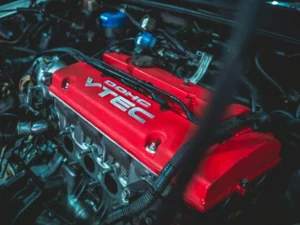
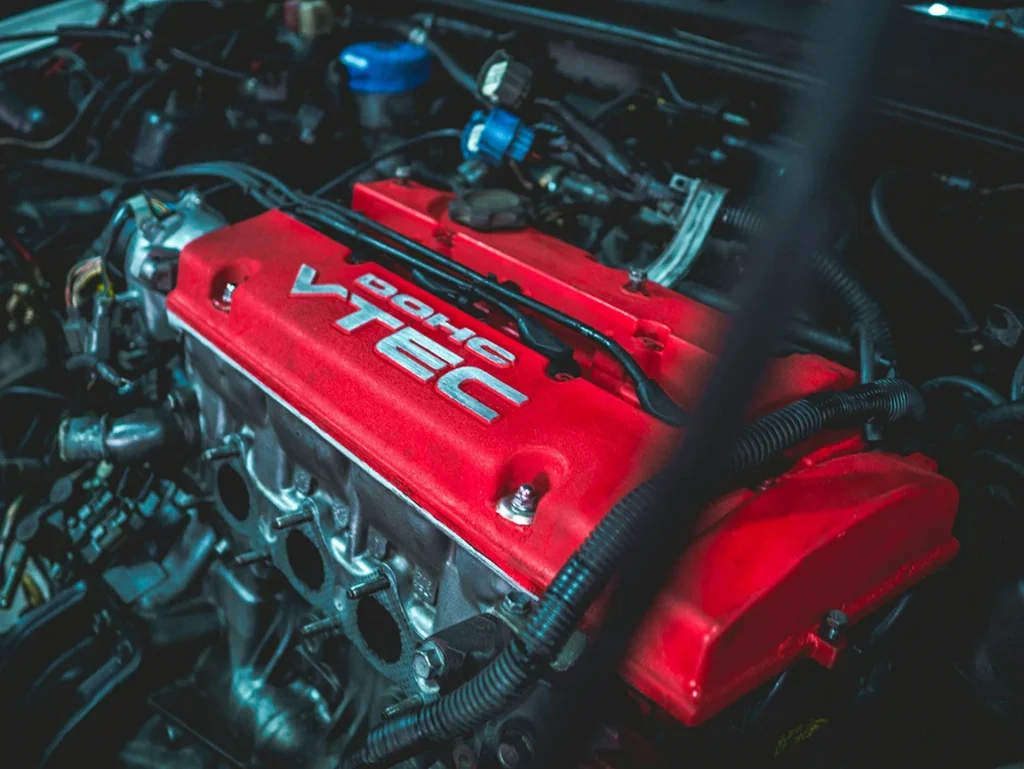
VTEC — Honda’s variable valve timing system — relies on oil pressure and a component called the VTEC solenoid to switch the engine between valve profiles as it revs. When that solenoid or its associated oil pressure switch develops a problem, it can trigger the check engine light and cause the engine to lose the smooth top-end power Honda drivers are used to. It’s a Honda-specific issue with a Honda-specific diagnostic path, and it’s exactly the kind of thing that benefits from a technician who works on these engines regularly rather than occasionally.
The same specialization applies across the brand’s known patterns — the particular engines prone to certain failures, the factory service intervals, the OEM parts and fluids that keep these cars running the way they were designed to.
When the Engine Stalls
An engine that dies unexpectedly — at idle, at a stop, or worse, while driving — is both alarming and diagnostically rich.
Stalling points to something interrupting one of the essentials of combustion: air, fuel, spark, or the sensor input that manages them. An idle air control problem, a failing fuel pump, a bad crankshaft position sensor, or a vacuum leak can each cut the engine off under different conditions. The circumstances matter enormously to the diagnosis — an engine that stalls only when cold behaves differently from one that stalls at every stoplight — which is why a good technician asks as many questions as they run tests.
The Cooling Connection
Some of the most serious engine damage doesn’t start in the engine at all. It starts in the cooling system.
An engine that overheats subjects its metal components to stress they weren’t built to survive, and one of the most common casualties is the head gasket — the critical seal between the engine block and cylinder head. A blown head gasket is frequently the downstream result of a cooling problem that went unaddressed, which is why engine and cooling health are so tightly linked. Keeping the cooling system in good order is, in a real sense, engine protection.
Repair, Rebuild, or Replace
At the far end of the spectrum sits the question every driver dreads: is the engine worth saving?
Most engine problems never come close to this. But when major internal damage occurs — spun bearings, severe overheating damage, a cracked block — the conversation shifts from repair to whether the engine should be rebuilt or replaced entirely. That decision depends on the specific damage, the value and condition of the rest of the vehicle, and the cost comparison between the two paths. It’s a decision that should be made with a complete and honest diagnosis in hand, never on a guess, because the numbers involved are large enough that getting the diagnosis right is the whole game.
The good news worth repeating is that the vast majority of engine repairs are nowhere near this territory. Catch problems early, honor the maintenance intervals, and most engines will return the favor with years of reliable service.
Getting an Honest Diagnosis
The thread running through every one of these problems is the same: accurate diagnosis is where good engine repair begins. So many engine symptoms overlap — a rough idle, a warning light, a strange noise can each trace back to several different causes — that the diagnostic process determines whether the repair actually solves the problem or just spends money near it.
Ian’s Auto Service has been diagnosing and repairing engines across the Tulsa metro since 1995, bringing Honda Master Technician expertise to Hondas, Acuras, and every major brand on the road. Our digital vehicle inspection puts photos of what we find in your hands, so you can see the condition of your engine for yourself rather than taking a description on faith. If something under your hood has changed — a new sound, a warning light, a loss of power — our team would be glad to take a look and give you a clear, straight answer about what’s going on.