

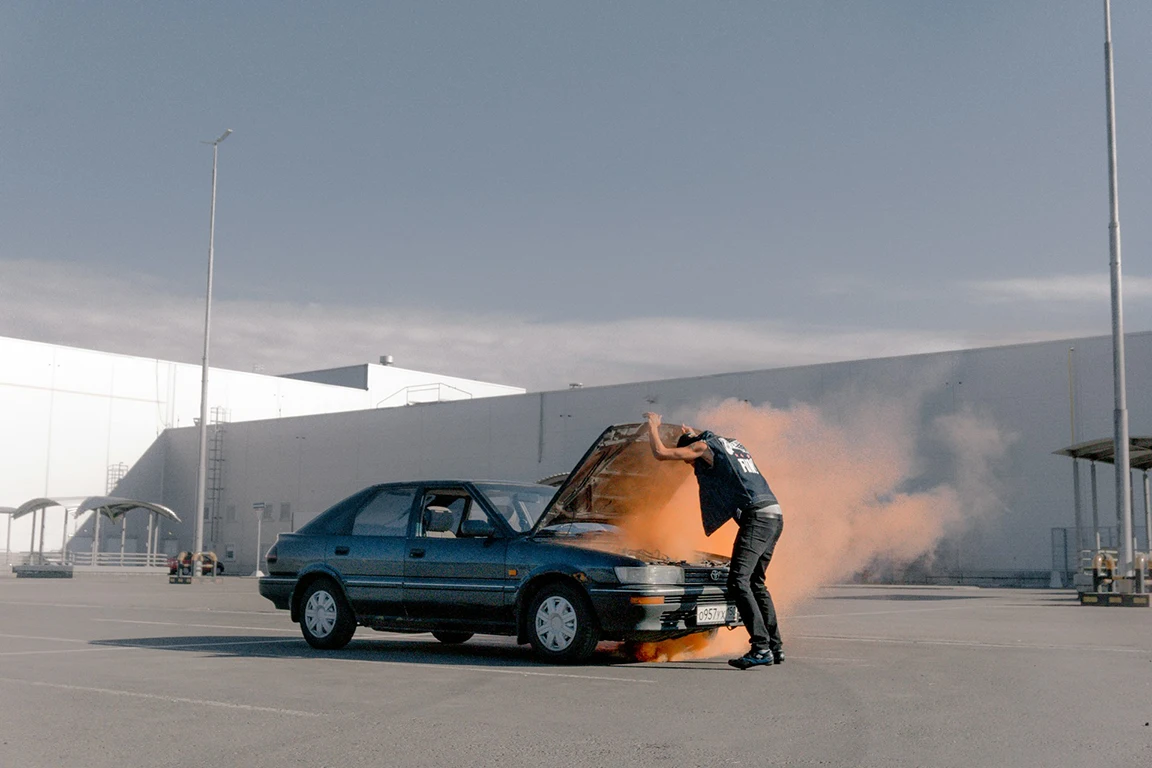
The temperature gauge sits right where it should while you’re cruising down the Broken Arrow Expressway, then starts creeping up the moment you hit a red light. By the time the light turns green, you’re watching the needle climb toward the danger zone and wondering whether you’ll make it home. Then you start moving again, and the temperature drops back to normal like nothing happened.
That specific pattern is telling you something important.
There are many reasons why your car could be overheating but if it’s only happening while idling then that actually helps clue us in on a smaller pool of potential causes. Understanding why the idle matters so much makes the problem far easier to track down, and it can save you from an expensive repair if you catch it early.
What Idling Overheating Tells You That Highway Driving Doesn’t
Your cooling system has one job: move heat away from the engine fast enough to keep it in a safe operating range. It does that by circulating coolant through the engine and out to the radiator, where airflow carries the heat away.
The key word there is airflow.
When you’re driving, air rushes through the radiator naturally as the car moves forward. That constant stream does most of the cooling work for you, which is why an engine often behaves perfectly at speed. The moment you stop or slow to a crawl, that free airflow disappears, and your engine has to rely entirely on the cooling fan to pull air through the radiator.
So when the temperature spikes specifically at idle, it usually means your cooling system is operating right at the edge of its capacity, and it can’t keep up the instant it loses that highway airflow. That narrows the field considerably. Instead of a long list of possibilities, you’re looking at the parts responsible for moving air and coolant when the car is sitting still.
The Cooling Fan Is the Usual Suspect
When overheating happens only at idle, the cooling fan is the first thing our technicians look at, and for good reason. At a stoplight, that fan is the only thing forcing air across the radiator. If it isn’t working, the engine has no way to shed heat until you start moving again.
A few fan-related failures can cause this:
- A failed electric fan motor, which simply stops spinning even though the engine is calling for it
- A bad fan relay or blown fuse, cutting power to a fan that is otherwise perfectly healthy
- A faulty temperature sensor or fan switch, which fails to signal the fan to turn on at the right moment
- A worn fan clutch on vehicles that use a belt-driven fan, allowing the fan to spin too slowly to move enough air
Here’s a simple check that points toward the fan: with the engine warmed up and the temperature climbing at idle, the cooling fan should be running. If it’s sitting still while your gauge rises, you’ve likely found the culprit. A proper diagnosis confirms whether the problem is the fan motor itself, the electrical circuit feeding it, or the sensor that tells it when to run.
Fan problems are common, frustrating, and thankfully among the more straightforward cooling issues to repair once the exact failure point is identified.
When Coolant Flow Is the Real Problem
Air is only half of the equation. The other half is coolant actually moving through the system, and at idle your engine circulates coolant more slowly than it does at higher RPM. That makes idle the moment when a weak flow problem reveals itself first.
A failing water pump is one of the more serious causes in this category. The pump’s impeller is what pushes coolant through the engine and radiator, and when it corrodes or wears down, circulation drops off. Because flow is already slowest at idle, a marginal pump often shows symptoms there before anything else, frequently alongside a coolant leak near the front of the engine or a whine from the pump bearing.
Low coolant is another frequent offender, and it ties directly into flow. When the level drops, often from a slow leak in a hose, the radiator, or the water pump, there simply isn’t enough coolant in the system to absorb and carry heat away efficiently. Air pockets form where coolant should be, and those pockets cause uneven cooling that tends to spike when the engine is working hard to cool itself at a standstill.
Then there’s the thermostat. This small valve opens to let coolant flow to the radiator once the engine reaches operating temperature. When it sticks closed, it traps hot coolant inside the engine and blocks the path to the radiator entirely. A stuck thermostat can cause overheating during driving too, but it often makes itself known at idle when the cooling system has the least margin to spare.
Radiator and Cap Issues That Show Up at Idle
A radiator that can’t do its job efficiently will struggle most when airflow is already at its lowest.
On the outside, years of bugs, road grime, and debris can pack into the radiator fins and block the air the fan is trying to pull through. On the inside, scale and sediment build up over time and restrict coolant flow, leaving the radiator unable to release heat the way it should. Either way, the loss of capacity becomes obvious at idle even when the car cools off fine at speed.
The radiator cap deserves a mention too, because it’s small, inexpensive, and easy to overlook.
A cooling system is pressurized on purpose, which raises the boiling point of the coolant and keeps it liquid at temperatures that would otherwise turn it to steam. A worn cap can’t hold that pressure, the boiling point drops, and coolant can boil over or escape exactly when the engine is hottest. It’s a humble part with an outsized effect.
Honda and Acura Cooling Systems: What to Know
Most Hondas and Acuras rely on electric cooling fans managed by the engine computer through the coolant temperature sensor and a set of fan relays. When one of those components fails, the symptom is classic: the temperature climbs at idle and at stoplights, then settles back down once you’re rolling and natural airflow takes over.
Because we’ve specialized in Honda and Acura since 1995, our Honda Master Technicians know exactly how these cooling systems are wired and where they tend to fail. We also know that using the correct coolant matters more than many drivers realize. Honda’s cooling systems are designed around genuine Honda OEM coolant, and substituting the wrong type can lead to corrosion and reduced performance over time. We use factory-correct fluids and OEM parts so your repair holds up the way the manufacturer intended.
That specialized knowledge means less guesswork, a faster path to the real problem, and a repair done right the first time.
What to Do When the Temperature Gauge Climbs at a Stoplight
If you find yourself watching the needle rise while you’re stopped, a few steps can protect your engine until you can get it looked at:
- Turn off the air conditioning, which removes a significant heat load and eases the demand on the cooling system
- Turn the heater on high, which sounds counterintuitive but pulls heat out of the engine and into the cabin, buying you a little breathing room
- Avoid sitting in extended idle; gently keeping the engine above idle when safe helps coolant circulate, and getting moving restores airflow
If the gauge reaches the red zone, you smell coolant, or you see steam, pull over safely and shut the engine off. Continued overheating can warp the cylinder head or blow a head gasket, turning a manageable repair into a major one. And never open the radiator cap on a hot engine, since the system is pressurized and the escaping coolant can cause serious burns.
The honest truth is that overheating is one of those problems where waiting almost always costs more. The sooner the root cause is identified, the smaller and less expensive the fix tends to be.
Get an Accurate Diagnosis Before Small Problems Become Big Ones
A car that overheats when idling is rarely a mystery once you know where to look, but pinpointing whether it’s the fan, the water pump, the thermostat, the radiator, or the cap takes the right equipment and experience. Our technicians use advanced diagnostic tools to find the exact cause rather than throwing parts at the problem, then explain clearly what’s happening and what your options are.
If your temperature gauge is creeping up at every stoplight, let our team take a look before the heat does lasting damage. We’ve kept Broken Arrow, Tulsa, and Coweta drivers cool and on the road since 1995, and we’d be glad to do the same for you.